Results: Why is yawning contagious

A yawn is a reflex consisting of the simultaneous inhalation of air and the stretching of the eardrums, followed by an exhalation of breath. Yawning (oscitation) most often occurs in adults immediately before and after sleep, during tedious activities and as a result of its contagious quality.

1.
1.
If seeing someone mid-yawn makes you involuntarily stretch out your mouth, you're not alone. In fact, you're among the 60-70% of people who find that seeing a person yawn in real life or a photo-or even reading about it-compels them to do the same thing. Do you agree seeing someone yawn in person, seeing an image of yawning, or even reading about yawning compels a person to actually yawn?
Yes
71%
•
1172 votes
No
13%
•
211 votes
Undecided
17%
•
277 votes
2.
2.
There are a number of theories that attempt to explain why humans and other animals yawn. It is likely that there are a number of triggers for the behavior. However, there are comparatively few theories that attempt to explain the primary evolutionary reason for the yawn. While a whole assortment of creatures, including hippos, pigs, snakes, chimpanzees and sharks, have been known to yawn, fewer species have been proven to "catch" yawns off one another in the way that humans (and even dogs) are prone to do. Here are some of the leading theories to answer the age-old question: Why is yawning so contagious, what "proposed causes" do you agree with?

One study states that yawning occurs when one's blood contains increased amounts of carbon dioxide and therefore becomes in need of the influx of oxygen (or expulsion of carbon dioxide) that a yawn can provide.[8] Yawning may in fact reduce oxygen intake compared to normal respiration. However, neither providing more oxygen nor reducing carbon dioxide in air decreased yawning.
21%
•
350 votes
Still another proposal points out that animals subject to predation or other dangers must be ready to physically exert themselves at any given moment. At least one study suggests that yawning, especially psychological "contagious" yawning, may have developed as a way of keeping a group of animals alert. If an animal is drowsy or bored, it may not be as alert as it should be to spring into action. Therefore, the "contagious" yawn could be an instinctual reaction to a signal from one member of the group reminding the others to stay alert.
12%
•
195 votes
Nervousness has also been suggested as a possible reason. Nervousness often indicates the perception of an impending need for action. Anecdotal evidence suggests that yawning helps increase the state of alertness of a person. Paratroopers have been noted to yawn in the moments before they exit the aircraft.
11%
•
183 votes
Another notion states that yawning is the body's way of controlling brain temperature. In 2007, researchers including a professor of psychology from the University of Albany proposed that yawning may be a means to keep the brain cool. Mammalian brains operate best within a narrow temperature range.
7%
•
118 votes
Also, yawning behavior may be altered as a result of medical issues such as diabetes, stroke, or adrenal conditions.
6%
•
94 votes
all
12%
•
192 votes
none
52%
•
858 votes
3.
3.
Yawning is often perceived as implying boredom, and yawning conspicuously in another's presence has historically been a faux pas. In 1663 Francis Hawkins advised, "In yawning howl not, and thou shouldst abstain as much as thou can to yawn, especially when thou speakest". George Washington said, "If You Cough, Sneeze, Sigh, or Yawn, do it not Loud but Privately; and Speak not in your Yawning, but put Your handkerchief or Hand before your face and turn aside." These customary beliefs persist in the modern age. One of Mason Cooley's aphorisms is "A yawn is more disconcerting than a contradiction." A loud yawn may even lead to penalties for contempt of court. Are you familiar with any of these old culture yawning facts?

Yes
28%
•
472 votes
No
72%
•
1188 votes
4.
4.
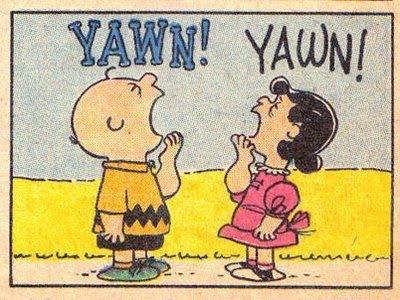
JUST FOR FUN: While taking this survey, did you find yourself yawning?
Yes
36%
•
600 votes
No
64%
•
1060 votes
Comments