Results: Megafauna That Once Called North America Home - Part 2 of 7

Extinct megafauna are large animals that have died out, including famous examples like the woolly mammoth, saber-toothed cats, and giant ground sloths, which lived during the Pleistocene epoch. Their extinction, which is largely believed to be as a result of human impact and climate change between 50,000 and 10,000 years ago, caused a major shift in ecosystems worldwide, particularly in Australia and North and South America. This series will explore 15 of these extinct animals that once roamed North America. Live Science is my source for this series. (Right click or tap and hold to view images in a new tab.)
1.
1.
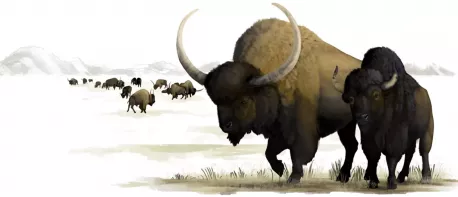
The ancient bison (Bison antiquus) lived from about 240,000 to 10,000 years ago, according to the National Park Service (NPS). It was 25% larger than the modern American bison (Bison bison), at 7.5 feet (2.3 m) high, 15 feet (4.6 m) long and 3,500 pounds (1,600 kg). Its horns were also longer than those of modern bison. These herbivores are likely ancestral to American bison, according to the NPS. Have you ever seen an American bison in its natural habitat?
Yes
30%
•
478 votes
No
50%
•
792 votes
Undecided
8%
•
122 votes
Not Applicable
13%
•
208 votes
2.
2.
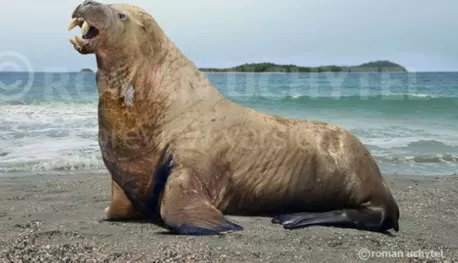
In 1980, researchers found the near-complete remains of Gomphotaria pugnax (ancient walrus) — a now-extinct giant pinniped — in Southern California. G. pugnax lived about 8.5 million to 5 million years ago, during the late Miocene epoch, the scientists reported in the journal Contributions In Science. Its large 18.5-inch-long (47 cm) skull had large upper and lower canine tusks. It was built more like a sea lion than a modern walrus, but featured tusks reminiscent of its extant relatives. Curiously, it also had two lower, forward-facing tusks. These were probably used to break open shellfish. The ancient walrus likely swam in shallow waters and used these tusks to stir up sediment on the seafloor while searching for food, most likely hard-shelled invertebrates such as mollusks. Have you ever visited an area where there were walruses?
Yes
18%
•
289 votes
No
61%
•
977 votes
Undecided
7%
•
114 votes
Not Applicable
14%
•
220 votes
Comments