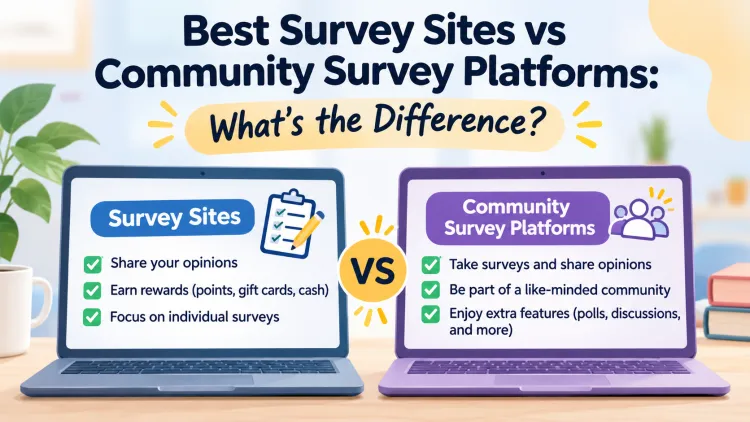
If you search for the best survey site, you will find a long list of options that look similar at first glance. Most promise easy access to questionnaires, a simple sign-up and a way to share your opinion. Underneath, though, they are built on very different models. Some are traditional survey sites that match you to studies commissioned by companies. Others are survey communities, where members create, answer and discuss questions with each other.
Understanding this difference helps you choose a platform that fits your goals, whether you want to answer surveys, run your own research or simply see what other people think. This guide explains how each model works, where they overlap, and how Tellwut differs from traditional survey sites.
What Is a Traditional Survey Site?
A traditional survey site is usually built around a closed system. Businesses, agencies or research firms write a questionnaire and send it to a pool of recruited respondents. The site's role is to screen participants, route them to suitable studies and deliver the results to the client.
How Traditional Survey Sites Work
The process usually follows a predictable path:
-
You register and complete a profile with demographic details such as age, location and interests.
-
The site matches your profile against the requirements of incoming studies.
-
You receive invitations, often by email, and answer a questionnaire.
-
The client receives the aggregated data. Participants rarely see the final results.
Many of these sites rely on market research panels, which are groups of pre-screened respondents maintained by a research company. Panels are useful when a brand needs responses from a narrowly defined audience, such as parents of toddlers in a specific region or users of a particular software product.
Strengths and Limits of Traditional Survey Sites
Traditional survey sites offer structure and controlled sampling. Researchers can set quotas, filter respondents and apply quality checks. For formal studies, that rigor matters.
The limits are just as clear. Participants have little say in which topics are asked about. They often face screening questions that end the survey early, and they seldom get to see how their answers compare with those of other people. The experience is mostly one-directional: the site asks, and you answer.
What Is a Community Survey Platform?
A community survey platform works on a different principle. Instead of acting only as a go-between for companies and respondents, it lets members take part in both sides of the conversation. People can answer polls, but they can also publish their own questions and see results in the open.
How Survey Communities Work
Survey communities tend to share a few traits:
-
Members can create and publish user-generated surveys on topics that matter to them.
-
Results are visible to participants, so people learn from the responses of others.
-
Topics are broad, from everyday habits and consumer preferences to public affairs and entertainment.
-
Interaction is part of the experience, through sharing, voting and following topics over time.
Because the content comes from the members themselves, the questions often reflect what real people are curious about, not only what a research client needs to know.
Strengths and Limits of Community Survey Platforms
The main strength is transparency and participation. You can see how opinions are distributed, test your own question with a real audience and explore trends as they develop. For small businesses, bloggers, educators and organizations, this lowers the barrier to collecting opinions without commissioning a full research project.
The trade-off is control. Open communities are not designed to guarantee a perfectly balanced sample in the way a managed research panel can. Results from user-generated surveys are best read as indicators of sentiment, not as statistically weighted data. Knowing this limit helps you use the findings responsibly.
Opinion Platforms: Where Do They Fit?
The term opinion platforms covers a wide range of services. It includes everything from poll widgets embedded in news sites to full survey communities and paid research panels. When you evaluate opinion platforms, it helps to ask three questions:
-
Who writes the questions: the platform's clients, the members, or both?
-
Who can see the results: only the client, or everyone?
-
How is the audience recruited and verified?
The answers place a platform on a spectrum between a closed research tool and an open community. Neither end is automatically better. The right choice depends on what you need from it.
Best Survey Site Criteria for Users Evaluating Options
When you compare platforms, a clear checklist saves time. Here are the factors that matter most.
Purpose
Decide whether you want to answer surveys, publish them, or both. A traditional survey site suits people who only want to respond to invitations. A community platform suits people who also want to ask questions and discuss results.
Transparency
Look for clear information about how data is collected, stored and used. A trustworthy platform explains its privacy practices, its advertising approach and how members can contact support.
Audience and Topic Range
A wide range of topics keeps the experience varied and makes it more likely that you will find questions relevant to you. If you plan to publish your own polls, check whether the audience is large and active enough to give you meaningful responses.
Ease of Use
A clean interface and mobile access make a real difference. Short polls and simple navigation encourage participation and reduce drop-off.
Quality of Results
Consider how results are displayed and whether you can interpret them easily. Clear charts and open access to aggregated answers make findings more useful, particularly for beginners. If you want to design stronger questions, these survey tips can help you avoid common mistakes such as leading wording or overly long questionnaires.
How Tellwut Differs From Traditional Survey Sites
Tellwut is an online community built around surveys, polls and questions. Instead of only sending members to studies commissioned by outside clients, it invites people to create their own polls, answer those created by others and view the results. The focus is on open participation and shared insight, which sets it apart from closed research panels. The comparison table below summarizes the main differences.
Comparison Table: Traditional Survey Sites vs Community Survey Platforms
|
Feature |
Traditional Survey Sites |
Community Survey Platforms (such as Tellwut) |
|---|---|---|
|
Who creates the questions |
Companies and research agencies |
Members, businesses and organizations |
|
Participant role |
Respondent only |
Respondent and creator |
|
Result visibility |
Usually private to the client |
Often visible to participants |
|
Audience |
Managed market research panels |
Open community of members |
|
Topic range |
Defined by client projects |
Broad, driven by member interest |
|
Sampling control |
High, with quotas and screening |
Lower, best for sentiment and trends |
|
Best suited for |
Formal, targeted research |
Quick opinion gathering and exploration |
|
Interaction |
Limited |
Sharing, voting and discussion |
Which Option Should You Choose?
There is no single answer, because the two models solve different problems.
Choose a traditional survey site or market research panel if you need a tightly defined audience, controlled sampling or data for a formal report.
Choose a community survey platform if you want to explore opinions quickly, publish your own questions, compare your views with others or build engagement around a topic.
Use both if your work benefits from layered insight. A community poll can reveal what people are talking about, and a formal panel study can then test those ideas with a controlled sample.
Practical Uses for User-Generated Surveys
User-generated surveys are useful in more situations than many people expect:
-
A small business can test product names, packaging ideas or service preferences before investing in a larger study.
-
A content creator can ask an audience which topics to cover next.
-
A teacher or student can run a quick poll for a classroom project.
-
A local organization can gather community feedback on events or priorities.
Businesses that use polls as part of their content approach may also find ideas in business blogging, since opinion data often makes a post more original and credible.
Tips for Getting Better Results From Any Survey Platform
Whichever model you choose, a few habits improve the quality of the data.
-
Keep questions short and neutral. Avoid wording that nudges people toward a particular answer.
-
Offer balanced answer options. Include a fair range of choices and, where relevant, a neutral or "not sure" option.
-
Limit the length. Shorter polls get more complete responses.
-
Define your goal first. Know what decision the results will inform before you write the first question.
-
Interpret with care. Treat open community results as directional unless the sample is designed to be representative.
Conclusion
The difference between traditional survey sites and community survey platforms comes down to who controls the questions, who sees the results and how the audience is built. Traditional sites and market research panels suit structured, targeted research. Survey communities and opinion platforms suit open exploration, quick feedback and participation from both sides of the conversation.
For people comparing options, the best survey site is the one that matches their goals, offers clear information about how data is handled and provides an experience they find easy to use. Tellwut offers a community-based approach for those who want to create polls, answer questions and see how opinions compare. If you would like to discuss how a community survey platform could fit your needs, contact our team and share your questions.
Frequently Asked Questions
1. What is the best survey site for beginners?
The best survey site for a beginner is one with a simple sign-up, clear instructions and an easy-to-use interface. If you only want to answer questions, a traditional site may be enough. If you would like to create polls and see results as well, a community platform is usually a better starting point.
2. What is the difference between a survey site and a survey community?
A survey site typically distributes studies from clients to a panel of respondents and keeps the results private. A survey community lets members create and answer surveys and often makes results visible to participants. The main difference is how much members take part in shaping the content.
3. Are market research panels better than survey communities?
Neither is better in every case. Market research panels offer controlled sampling and screening, which suits formal research. Survey communities offer open participation and faster access to public opinion, which suits exploration and engagement. The right choice depends on the purpose of the project.
4. Are user-generated surveys reliable?
User-generated surveys are reliable as indicators of opinion and interest, especially when questions are well written. They are not designed to replace statistically weighted studies, so results should be read as trends and not as exact measurements of a whole population.
5. Can businesses use opinion platforms for research?
Yes. Businesses can use opinion platforms to test ideas, collect early feedback and understand audience preferences. For decisions that require high precision, it is sensible to combine these insights with a more structured research method.
6. How does Tellwut differ from traditional survey sites?
Tellwut is a community platform where members can create polls, answer questions from others and view results. Traditional survey sites usually keep the process closed and focus on delivering data to the clients who commission the studies. Tellwut emphasizes open participation and shared insight.

Comments