Results: Left to Die on the Isle of Demons (Part 5 of 5)

While sailing from France to Canada in 1542 as part of a mission to spread the Holy Catholic faith, expedition leader Jean-Francois de la Roque de Roberval was furious when he discovered his relative Marguerite de la Roque was having an affair with a man onboard the ship. Driven by his fury over her bringing disrespect to their family name or perhaps intending to assume sole possession of the land they shared ownership of in France, Roberval abandoned Marguerite, her lover, and her servant on the uninhabited Isle of Demons. Marguerite was the only survivor, and after 2 more years alone, was rescued by the crew of a French fishing vessel and returned to France.

1.
1.
A Protestant, Roberval's expedition to spread the Holy Catholic faith in Canada failed. His colony lasted less than two years and was represented by his cruel leadership, severe hardship, scurvy, and hostile relations with the local Iroquois - leaving no record of any religious conversions. His hopes of enriching himself collapsed when the "gold" and "precious stones" he sent to France were merely iron pyrite (pictured) and mica. He returned to France, where he never faced consequences for marooning 3 people on an uninhabited island, presumably to die. Thoughts?
He was a friend of King Francis I since childhood. Of course he was not charged.
15%
•
140 votes
He talked his way out of it by spinning the story, justifying his behavior.
12%
•
117 votes
At the time, few people were aware of what he had done.
19%
•
182 votes
People in charge of upholding the law thought his behavior was justified.
8%
•
81 votes
How outrageous!
15%
•
139 votes
Other
2%
•
15 votes
N/A
47%
•
444 votes
2.
2.
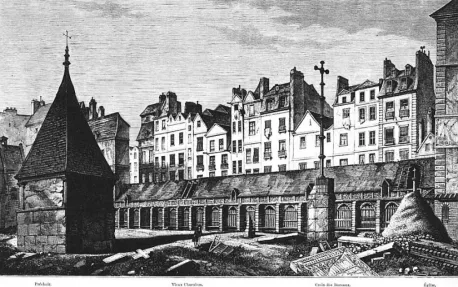
During the French Wars of Religion, Roberval was assassinated in 1560 leaving a Huguenot (Reformist Protestant) church meeting. He and his companions were beaten to death by a Catholic mob near the corner of the Cimetiere (Cemetery) des Innocents (pictured). What do you think motivated Captain Roberval to exile Marguerite and her companions on an uninhabited island?
He was driven by religious moral outrage that his relative, a single woman, would have an affair.
14%
•
132 votes
He was livid that his relative Marguerite had brought shame to his family name.
19%
•
185 votes
He did so because he felt her behavior was an insult to his authority and power.
16%
•
149 votes
He wanted to set an example of the consequences for immoral behavior for the hundreds of other people he was transporting to the new colony in Canada.
12%
•
114 votes
He wanted to gain sole possession of the land in France that he and Marguerite co-owned.
15%
•
139 votes
Other
2%
•
23 votes
N/A
48%
•
459 votes
3.
3.
Whose account of the initial stranding of Marguerite, her lover, and her servant Damienne do you find more believable? The Queen of Navarre wrote that Captain Roberval told her that he put the LOVER off the ship, and Marguerite chose to join him. Historian and Franciscan friar Andre Thevet (pictured) claimed to have spoken to Roberval and Marguerite, and wrote that Roberval put MARGUERITE ashore, and the lover jumped off the ship and swam to join her.

The Queen's version is doubtful because she would have chosen to depict Roberval favorably because of his friendship with her brother, King Francois I who sent Roberval to Canada.
9%
•
83 votes
Since the Queen did not talk to Marguerite and only spoke with Roberval, her entire expansive report of their stay on the island is suspect as she was not there.
12%
•
117 votes
Historian Andre Thevet would more likely be impartial and unbiased in his version of the story, and he spoke with both Roberval and Marguerite.
12%
•
115 votes
The Queen shared much information about the situation, and was most likely more accurate.
4%
•
36 votes
As an historian, being factual was more important to Andre Thevet.
7%
•
66 votes
N/A
56%
•
537 votes

Comments