Results: Great Blue Turaco
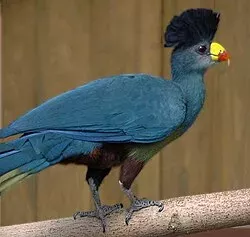
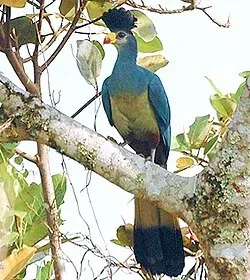
The great blue turaco (Corythaeola cristata) is a bird species of the family Musophagidae. At 70–76 cm (28–30 in) in length, it is the largest species of turaco. It has predominantly grey-blue plumage with an upright blue-black crest around 10 cm (3.9 in) high. The male and female have similar plumage. It is widespread throughout the African tropical rainforest. - Wikipedia is the source for this survey.
1.
1.
The great blue turaco is the sole member of the subfamily Corythaeolinae within the turaco family. Its closest relatives are the go-away birds and plantain eaters of the genus Crinifer. The common ancestor of both diverged from the ancestor of all other turaco species. "Great blue turaco" has been designated the official common name by the International Ornithologists' Union (IOC). Were you aware of these birds also called the blue plantain eater?
Yes
9%
•
87 votes
No
75%
•
703 votes
Undecided
16%
•
146 votes
2.
2.
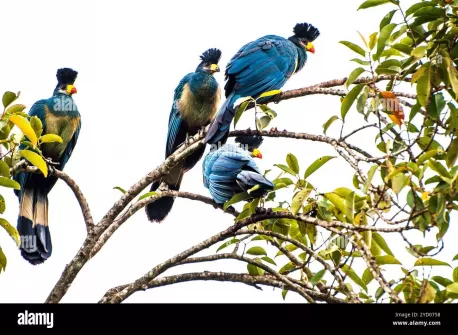
The species ranges from Guinea in the west, and east across the sub-Saharan nations to the Imatong Mountains in South Sudan; it also occurs in Uganda, Tanzania and western Kenya, south to the Democratic Republic of Congo and Angola. It inhabits rainforests and gallery forests. It has also adapted to areas cleared by humans and can thrive in these areas. The great blue turaco is gregarious, with birds forming small troops of some six or seven individuals. If there were no obstacles for you to travel, would you like to see these beautiful birds in the wild?
Yes
51%
•
475 votes
No
25%
•
238 votes
Undecided
24%
•
223 votes
3.
3.
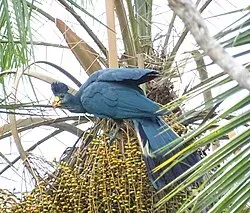
The great blue turaco eats leaves, flowers, as well as fruit of many plant species. In Kenya, it has been recorded eating mitzeeri in April, loquat in July, guava in September and Cordia over November and December. Fieldwork in Rwanda revealed leaves constituted around 25% of its diet, being eaten more often when fruit is less abundant. The species also play a role in seed dispersal as it generally passes seeds some distance from their parent trees. I've eaten guava jelly and loquats in my youth in Florida. Would you like to eat some of the different kinds of fruit that the great blue turaco does in the wild?
Yes
27%
•
251 votes
No
32%
•
297 votes
Undecided
41%
•
388 votes
4.
4.
Highly regarded as food in West Africa, it is often hunted and eaten by local people. The BaMbala and related tribes around the town of Kikwit in the Democratic Republic of Congo, call the great blue turaco kolonvo. The meat is popular in smaller villages, and the long tail feathers are prized for decorations. Some people raise chickens and ducks for food. Would you be interested in raising exotic fowl like the great blue turaco as a food source?
Yes
10%
•
98 votes
No
68%
•
632 votes
Undecided
22%
•
206 votes
Comments