Results: Yes, Spelling Does Matter

1.
1.
We all know spelling matters. You may have heard "it's the difference between KNOWING YOUR CRAP, and KNOWING YOU'RE CRAP" but the English language is full of confusing words that confuse even the best speller. How many of these words do you often get mixed up?
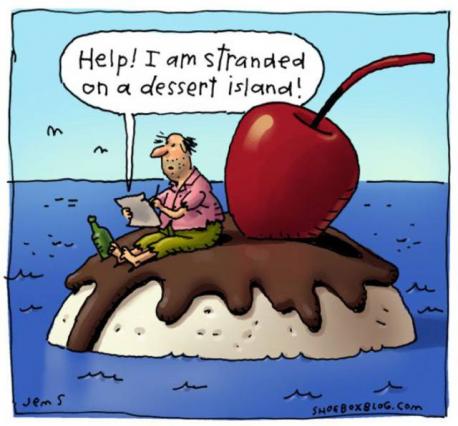
Dessert vs desert -- one is the sweet treat at the end of the meal vs a dry, barren landscape (my English teacher used to tell us the dessert has the cherry on top (the extra S)
15%
•
262 votes
Cereal vs serial -- one you eat, vs one you repeat
5%
•
90 votes
Foreword vs forward -- one is an introduction vs moving ahead
8%
•
144 votes
Your vs you're -- one is the possessive vs one is the contraction of "you are"
9%
•
162 votes
Vain vs vane vs vein -- if you're conceited you are vain, vs a stabilizing blade vs a blood vessel
6%
•
95 votes
Than vs then -- one is used for comparisons vs one is used to indicate time or sequence
11%
•
191 votes
To vs two vs too -- One is a preposition used for direction vs the number vs a word for also
7%
•
125 votes
Their vs there vs they're -- one is used for possessive vs one is used for a place, vs one is the contraction of "they are"
7%
•
126 votes
None of them
61%
•
1052 votes
I confess -- all of them!
5%
•
90 votes
2.
2.
English is probably one of the hardest languages to learn. So many rules, and so many exceptions to the rules. How many of these rules and their (not there or they're) exceptions are you familiar with?
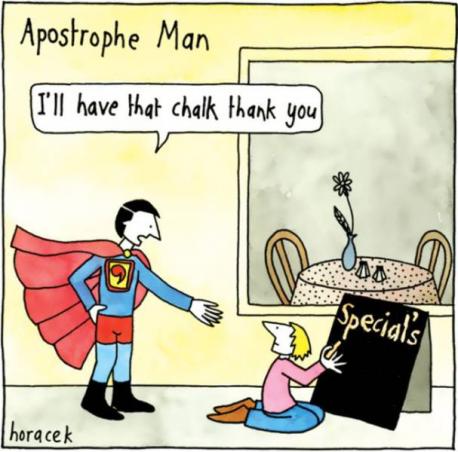
The word ending meaning "able to be" should sometimes be –able, as in acceptable and sometimes should be –ible as in invincible. Most of the time, if you've still got a full word when you strip the ending off (accept+able), you should go with –able. If you're left with something that isn't a full word (invinc+ible) go with –ible. Watch out for the small set of –ible words that do attach to full words (accessible, convertible, flexible) and for non-full word stems that end in a hard c or g sound. Those take –able (amicable, despicable, indefatigable, navigable).
15%
•
264 votes
When adding –ed or –ing to a verb, sometimes you should double the final consonant (refer becomes referring) and sometime you shouldn't (enter becomes entered). Generally, do not double the consonant unless you've got a one syllable word that ends with a single vowel followed by a single consonant (hit to hitting, stop to stopping) or a two syllable word that ends in same way and has stress on the second syllable (admit to admitted, begin to beginning). Some words are acceptable with or without the doubling, such as canceled/cancelled or traveled/travelled.
22%
•
375 votes
You may have heard the rule "i before e except after c." This doesn't work if the word has an "ay" vowel sound (as in weigh, neigh, sleigh), comes from the Latin root sci- (science, conscience, omniscient), is the plural of a word ending in –cy (mercies), doesn't have an "ee" vowel sound (heir, their), or is just one of those words that doesn't follow any of the rules (protein, weird, ancient, seize).
22%
•
385 votes
Add –es to make a plural if the word ends in sh (bushes), ch (churches), x (boxes), s (kisses), or z (waltzes). If the word ends in f, change it to v and add -es (half/halves, knife/knives). Otherwise, just add -s.
21%
•
359 votes
All
35%
•
607 votes
None
32%
•
548 votes
3.
3.
So how did some of our most confusing words to spell actually get those spellings? Why is it "knead" or "thought"? How many of these spelling mysteries did you know about?
Knead -- It rhymes with need and it's what you do to dough to make bread, but why do we need the /k/? This oddity dates back to the early sixteenth century when Gutenberg's printing press was becoming the standard method for making books. Now that publishers (instead of scribes) were having their say, they standardized spellings as they saw fit. It also happens to be during a period referred to by linguists as The Great Vowel Shift. People were pronouncing vowels differently but the publishers apparently didn't take note. Words with /ea/ sounds especially suffered as knead, head, bear and great all have different sounds. In addition to the vowels changing, /gn/, /wr/, and /kn/ words lost the sound of their first letter, but retained their archaic spelling.
18%
•
307 votes
Thought -- Way back in the 600s, Christian missionaries arrived in Anglo-Saxon England with their Roman alphabet and tried to make it fit the language they found there. They had to come up with ways to spell sounds like 'th' and /x/—a back of the throat consonant like the one in German "ach!" For a while they made use of runic characters and various combinations of g, c, and h. Scribes eventually settled on 'th' and 'gh'. Later, English lost the /x/ sound, but only after the spelling conventions had been well established.
15%
•
251 votes
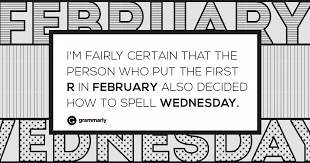
February -- We're all familiar with silent letters that appear at the beginning and end of words, but there's a silent /r/ right in the middle of this one that's not a result of the aforementioned Great Vowel Shift. In the 16th and 17th centuries, people started to re-introduce Latin roots to a lot of words. Apparently making words look more classical also makes them appear fancier and thus the user appears more intelligent. So, the word for the second month of the year looks more like Februarius despite the confusion that was bound to ensue.
15%
•
263 votes
Island -- More Latinizing but what is surprising, however, is that island comes from the Old English iillond and has no connections with Latin whatsoever. The powers that be again wanted to torment English learners when they decided an additional /s/ (in reference to the Latin insula) would somehow be a good idea.
11%
•
187 votes
Colonel -- The spelling and pronunciation are almost never further apart than they are here. There were two different spellings and pronunciations of the word from the time it was introduced to English (coronel and colonel) and instead of keeping and pronouncing the /r/ versus the /l/, they decided to split the difference and spell it with /l/ and pronounce the /r/.
12%
•
203 votes
Receipt -- The Latinizing frenzy is to blame again. Though no one pronounced a /p/ when it was introduced to English from French, those in power decided (for apparently no reason) that it would look better if it was squeezed in anyway. Now the word looks more like the Latin receptus and is a terror for grammar school children and English learners worldwide.
14%
•
234 votes
None
66%
•
1137 votes
4.
4.
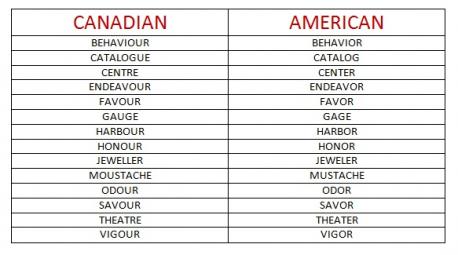
Now, a little while back, someone mentioned that people are always spelling "color" wrong, as "colour". Well, guess what? This is perfectly acceptable as either spelling. These variations in spelling exist because of differences between American English and British English. Color is the spelling used in the United States. Colour is used in other English-speaking countries, including my country, Canada! Same with favor/favour, savior/saviour, valor/valour...you get the point. We also spell many other words differently, not wrong. Did you notice these spelling differences between Canadians and Americans before this survey?
Yes
63%
•
1080 votes
No
37%
•
634 votes

Comments