Results: 10 top etiquette rules: do you follow them or break them?
Core Rules of Netiquette:
Rule 1: Remember the Human
Rule 2: Adhere to the same standards of behavior online that you follow in real life
Rule 3: Know where you are in cyberspace
Rule 4: Respect other people's time and bandwidth
Rule 5: Make yourself look good online
Rule 6: Share expert knowledge
Rule 7: Help keep flame wars under control
Rule 8: Respect other people's privacy
Rule 9: Don't abuse your power
Rule 10: Be forgiving of other people's mistakes (what a concept!!!!!)
1.
1.
Here are ten ever so important etiquette rules. Check off the ones that you follow/adhere to:
The right hand is for waving and shaking hands (using the left hand is for sneezing or coughing into)
23%
•
413 votes
Your purse should be on the left shoulder, and on the floor to your right at dinner time
10%
•
171 votes
Handbag is the correct term if it's expensive, purse is regarded to be less expensive
9%
•
166 votes
If you pass the salt or the pepper, you pass both (think of them as a married couple)
14%
•
243 votes
The correct way to applaud is just slightly to your left, about chest height. You never want to clap in front of your face.
12%
•
205 votes
The seat in the back of the limo is far right, which is for the boss, then load in towards the left
4%
•
76 votes
When you get into a car, you sit then swing your legs in
19%
•
337 votes
Never point at someone. You can point at something, but never a person
33%
•
585 votes
When faced with a revolving door, it's polite to enter first, never let the other person be in the position to have to push
10%
•
179 votes
N/A
42%
•
739 votes
2.
2.
Did you find this list to be antiquated?
Yes
38%
•
665 votes
Not sure
28%
•
501 votes
No
16%
•
285 votes
N/A
18%
•
315 votes
3.
3.
Do you know the difference between etiquette and manners?
Yes
48%
•
849 votes
No
23%
•
407 votes
Undecided
15%
•
261 votes
Not Applicable
14%
•
249 votes
4.
4.
Check off what you know, regarding etiquette and manners:
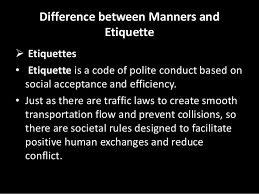
The primary distinction between etiquette and manners is that the first includes specific rules of conduct, while the other is more generalized.
31%
•
540 votes
Manners involve general behavioral guidelines, such as treating the elderly with respect and courtesy.
44%
•
780 votes
Etiquette is a specific code of behavior, with an example of etiquette being knowledge of the proper mode of address for a queen, which is, incidentally, Your Majesty.
34%
•
597 votes
Many of the rules of etiquette are already practiced by people with good manners, and a demonstration of familiarity with good manners will mark someone as cultured, polite company.
31%
•
555 votes
People are typically taught manners from a very young age
41%
•
730 votes
Children learn, for example, that it is not polite to stare, to make personal comments (like telling a Jew that their head will explode by leaving the O out of G-d)
30%
•
526 votes
In childhood, people usually absorb lessons about how to treat others and how to behave in a variety of situations.
36%
•
627 votes
Manners often become second nature when they are taught at a young age.
43%
•
755 votes
N/A
30%
•
533 votes
5.
5.
When did you learn etiquette or manners or both?
I learned as a child
58%
•
1021 votes
I learned as a teen
4%
•
64 votes
I learned as I went, growing up over a range of time
18%
•
323 votes
Don't remember
11%
•
197 votes
I have never learned either etiquette or manners
8%
•
141 votes
Other (please specify)
1%
•
20 votes
| Other Answers | Percentage | Votes |
| 0.74% | 13 | |
| na | 0.23% | 4 |
| I was born with manners. | 0.06% | 1 |
| N/A | 0.06% | 1 |
| english dont have manner | 0.06% | 1 |

Comments